Heathrow Train Disruption Continues After Trackside Fire Damages Key London Rail Route
 Published By
Adam
Published By
Adam
Published:
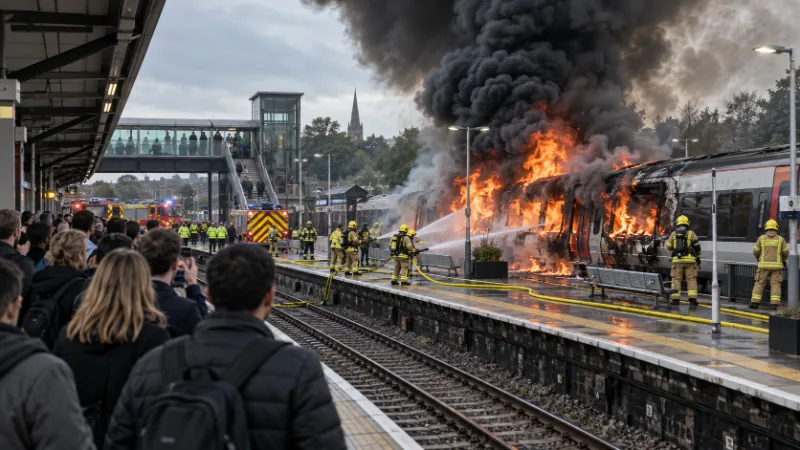
Passengers travelling between central London and Heathrow Airport are facing further disruption on Monday after a trackside grass fire in west London damaged railway power infrastructure and forced hundreds of people to be evacuated from a stranded Elizabeth line train.
The disruption began on Saturday, 5 September, when a fire broke out beside the railway near Scrubs Lane in North Kensington, affecting the Great Western Main Line between London Paddington, Heathrow Airport and Reading.
Despite the fire being brought under control on Saturday evening and trains beginning to move again on Sunday, its effects have continued into Monday, 7 September 2026, with changes to Elizabeth line, Heathrow Express and Great Western Railway services.
The most significant problem for airport passengers is on the Elizabeth line to Heathrow Terminal 5.
National Rail confirmed that Elizabeth line trains will not serve Heathrow Airport Terminal 5 on Monday as the railway continues to deal with the consequences of the weekend incident.
Services normally operating between Shenfield and Heathrow Terminal 5 are instead running only as far as London Liverpool Street. Passengers coming from stations between Shenfield and Stratford have been advised to change at Whitechapel for an Elizabeth line service towards Heathrow Terminal 4.
Free transfers are available between Heathrow terminals, while passengers can also use the Piccadilly line between central London and Heathrow at no additional cost where the relevant ticket arrangements apply.
Heathrow Express is also operating a reduced service, while Great Western Railway passengers have been warned that some trains between London Paddington and Reading could be cancelled or revised.
Latest Monday-morning reports showed severe delays on parts of the Elizabeth line, including between Heathrow Terminals 2 & 3 and Terminal 5 and between Hayes & Harlington and Reading.
The disruption is particularly significant because the affected corridor carries not only airport travellers but also large numbers of London commuters and long-distance GWR passengers travelling towards Reading, Oxford, Bristol, South Wales and the West Country.
What Caused the Heathrow Train Disruption?
Despite being widely described as a “Heathrow fire”, the blaze did not start at Heathrow Airport.
London Fire Brigade confirmed the incident was a grass fire close to Scrubs Lane in North Kensington, several miles east of the airport.
The Brigade was called at 4.11pm on Saturday. Six fire engines and around 40 firefighters from Hammersmith, Paddington, Ealing and surrounding stations were sent to the scene.
The fire affected infrastructure beside the Elizabeth line and Great Western Main Line into London Paddington.
National Rail said the blaze resulted in an electricity supply failure, initially leaving all railway lines between Paddington and Heathrow blocked.
Photographs subsequently released from the area showed damaged and blackened railway infrastructure after the fire, illustrating why the effects continued even after firefighters had extinguished the flames.
The London Fire Brigade said the incident was finally under control by 8.36 pm on Saturday.
However, restoring rail services was considerably more complicated than simply extinguishing the grass.
Electrical distribution equipment serving the railway was damaged, meaning engineers needed to assess and repair infrastructure before services could return to their normal operating pattern.
That has left railway operators dealing with the consequences more than a day after the original emergency.
One of the most serious moments came when an Elizabeth line train became stranded during the power failure.
Around 380 passengers were safely evacuated from the train by London Fire Brigade crews working alongside Transport for London. No serious injuries were reported by the Brigade in its published incident update.
The number of passengers involved shows how quickly a comparatively localised lineside fire can develop into a major transport incident on one of Britain’s busiest railway corridors.
The Elizabeth line carries passengers directly through central London to Heathrow, while the same western railway corridor is shared with Heathrow Express and GWR.
When its electrical supply was affected, the impact therefore spread well beyond the immediate location of the blaze.
Monday’s disruption has also created some confusion over reports of vandalism.
Great Western Railway information cited in Monday’s live travel updates said vandalism to railway equipment between Reading and London Paddington was contributing to fewer trains being available, with services potentially revised or cancelled.
However, this should not yet be interpreted as confirmation that vandalism started the original grass fire.
London Fire Brigade’s official incident record describes Saturday’s emergency as a grass fire, while the publicly available National Rail information initially attributed the railway shutdown to the resulting electricity supply failure.
Unless investigators or Network Rail subsequently establish a direct connection, the safest distinction is that vandalism has been cited in relation to damaged railway equipment and Monday’s continuing disruption, while the precise ignition cause of Saturday’s grass fire has not been publicly established in the official material reviewed.
That distinction matters as reports about a fast-moving transport incident can change significantly as engineers and investigators inspect the site.
Train services had initially recovered on Sunday morning.
National Rail said disruption from the original fire to Elizabeth line, Heathrow Express and Great Western Railway services had ended, although separate planned engineering work between Paddington and Ealing Broadway was also affecting some journeys.
A signalling fault between Paddington and Ealing Broadway then caused another round of disruption on Sunday, with trains delayed, cancelled or revised before the lines reopened.
The result has been an unusually difficult weekend for passengers using Paddington and Heathrow’s rail connections, with fire damage, planned engineering works and a signalling failure occurring in close succession.
For passengers travelling on Monday, the clearest confirmed restriction is at Heathrow Terminal 5.
National Rail’s current advice states that Elizabeth line Terminal 5 services are not operating through from central and east London in their normal pattern.
People travelling from central London still have several alternatives.
Elizabeth line passengers can travel towards Heathrow Terminal 4 and use free terminal transfers where necessary, while the Piccadilly line continues to provide a direct Underground connection from central London to Heathrow.
Heathrow Express passengers should check the timetable before travelling because services are running at a reduced frequency.
GWR passengers using the Paddington-Reading corridor have also been advised to check individual journeys rather than assume the normal timetable will operate.
That advice is especially important for passengers connecting with flights.
An airport rail delay of 20 or 30 minutes can become much more consequential when travellers also need time for check-in, baggage drop and airport security.
The disruption demonstrates the importance of the western approach to Paddington within London’s transport network.
Although the Elizabeth line has its own identity as a cross-London railway, its western branch shares infrastructure with other services. Damage to power or signalling equipment on that corridor can therefore affect several operators simultaneously.
Saturday provided an unusually clear example.
A grass fire beside a relatively small section of railway led to:
- the temporary blocking of all lines between Paddington and Heathrow;
- suspension and cancellation of Elizabeth line services;
- cancellation of Heathrow Express trains;
- disruption to GWR services towards Reading;
- and the evacuation of around 380 people from a stranded train.
The incident also came during a period of warm and dry conditions in which grass and vegetation beside transport infrastructure can become more vulnerable to fire.
Railway lines present an additional challenge because firefighting operations may require power supplies to be isolated before emergency personnel can safely work close to electrical equipment.
Even after flames are extinguished, engineers then need to inspect overhead equipment, power distribution systems, signalling infrastructure and track before full operations can resume.
That helps explain why passengers can continue seeing timetable changes long after the visible emergency has ended.
The immediate firefighting operation itself is now over.
London Fire Brigade’s official record says firefighters safely dealt with the North Kensington grass fire on Saturday evening.
The issue confronting passengers on Monday is therefore the damage and operational consequences left behind by the fire, rather than an ongoing blaze.
National Rail’s Terminal 5 travel notice currently applies for Monday, 7 September, while live reporting says disruption on affected services is expected to continue through the day.
Passengers should therefore check their specific service immediately before leaving home rather than relying on the timetable originally shown when a journey or flight was booked.
For Heathrow travellers, the Piccadilly line provides the most obvious direct alternative from central London if their normal Elizabeth line or Heathrow Express journey is affected.
Those using the Elizabeth line should also pay close attention to which Heathrow terminal their train actually serves, particularly passengers heading for Terminal 5.
The disruption comes little more than a year after Heathrow’s wider resilience came under intense scrutiny following the major North Hyde electrical substation fire in March 2025, which caused a power outage and resulted in the airport itself closing for much of the day.
Saturday’s incident is substantially different: the airport has not been shut and the fire was beside railway infrastructure rather than at Heathrow’s power supply.
But once again, the episode demonstrates how disruption to critical infrastructure outside an airport terminal can quickly affect thousands of journeys.
For now, Heathrow remains accessible and flights are continuing, but passengers travelling by rail are being urged to allow additional time and check their route before setting off.
The most important distinction for travellers is also the simplest: Heathrow Airport itself is not closed because of this fire. The continuing problem is primarily affecting rail connections to and from the airport.
As repair and recovery work continues, further short-notice timetable changes remain possible across the western Elizabeth line, Heathrow Express and Great Western Railway network.
About the Journalist
Adam reports on London news, events and local developments. His coverage includes festivals, exhibitions, public announcements, community stories and important updates affecting people across the city. He aims to provide timely and accessible reporting on what is happening in London.